
The $75 Billion-Dollar Question: What Will Be the Trading Range of SpaceX Stock on June 12, 2026?
Former Global Chief Economist for JPMorgan Chase (Ph.D in Economics) & Current Global Keynote Speaker

Numerous readers have reached out to ask me for an objective prediction of what might happen during SpaceX’s first day of trading on the public market.
Few initial public offerings in modern financial history have generated as much anticipation as SpaceX’s scheduled June 12, 2026, debut. The company’s decision to price its IPO at $135 per share and raise approximately $75 billion, with underwriters potentially exercising options to sell an additional $10 billion of stock, has created one of the largest and most unconventional public offerings ever attempted. Investors, analysts, portfolio managers, and index providers are all trying to answer the same question: where will SpaceX trade once the opening bell rings?
The answer is surely up for vigorous debate. Traditional valuation methods suggest that the IPO price may already be aggressive. Yet market structure, passive fund flows, scarcity of publicly available shares, and investor enthusiasm surrounding founder Elon Musk could push the stock far beyond what conventional valuation models would imply. The result is a rare situation in which fundamental value and the market-clearing price are far apart!
The debate on Wall Street begins with valuation. The company is expected to debut with an equity valuation approaching $1.75 trillion to $1.8 trillion. Bulls argue that such a valuation understates the long-term opportunity represented by reusable launch systems, satellite communications, defense contracts, global broadband infrastructure, and future space-based industries. Some of the most optimistic and extreme forecasts I have seen are from CNBC’s Jim Cramer, who has said the company’s valuation could briefly reach as much as $5 trillion on the first day of trading and then drop shortly thereafter. Under this scenario, the share price could jump to $380.
Market bears see a very different picture. Skeptics point out that aerospace remains a capital-intensive business subject to regulatory risk, technological uncertainty, and execution challenges. Some analysts estimate a fair value closer to $780 billion, implying a share price near $60. They argue that the current valuation already discounts decades of future growth and assumes extraordinary success across multiple business segments. From this perspective, the IPO price itself may represent an overvaluation.
However, opening-day trading rarely depends solely on a company’s fundamental value. Market mechanics often matter more than valuation models in the initial price discovery process. In SpaceX’s case, those mechanics may prove especially powerful given the company’s relatively small public float relative to its overall valuation.
Although SpaceX will be valued at nearly $1.8 trillion, only a small percentage of shares will trade publicly at first. Depending on final allocations and underwriting options, roughly $75 billion to $ 85 billion in stock may be available to public investors. That means a substantial portion of the company’s equity will remain locked up in the hands of insiders, early investors, employees, and founders.
This limited float will likely create a scarcity effect. Simply put, there may not be enough shares to meet immediate demand from both active and passive investors. When demand exceeds supply, prices tend to rise until equilibrium is reached. This pattern has been observed repeatedly in high-profile IPOs, particularly those involving iconic companies with strong retail and institutional followings.
The forced buying associated with index inclusion may become one of the most important drivers of early trading. Estimates suggest that passive index funds may need to purchase between $20 billion and $30 billion of SpaceX stock in the first several weeks after the IPO. Nasdaq-100 trackers alone could account for approximately $7-$8 billion in demand. Russell Index products may contribute several additional billions. The recent decision by MSCI to allow accelerated inclusion could generate another $4 billion to $6 billion of mechanical buying. Collectively, these flows represent a substantial share of the publicly available float.
Importantly, this buying is not discretionary. Portfolio managers overseeing passive funds do not have the option of deciding whether SpaceX is overvalued or undervalued. Their mandate requires them to purchase the stock if it enters the benchmark they track. Such buying tends to occur regardless of price, thereby amplifying upward momentum when share availability is limited.
The offering’s unusual structure further complicates valuation. Traditionally, underwriters conduct a roadshow, gauge investor demand, and adjust pricing shortly before the IPO. SpaceX chose a different path, effectively fixing its offering price in advance. While this approach creates certainty about the IPO price, it shifts much of the valuation debate to the secondary market. As a result, the first few trading sessions may become an unusually important mechanism for discovering the market-clearing price.
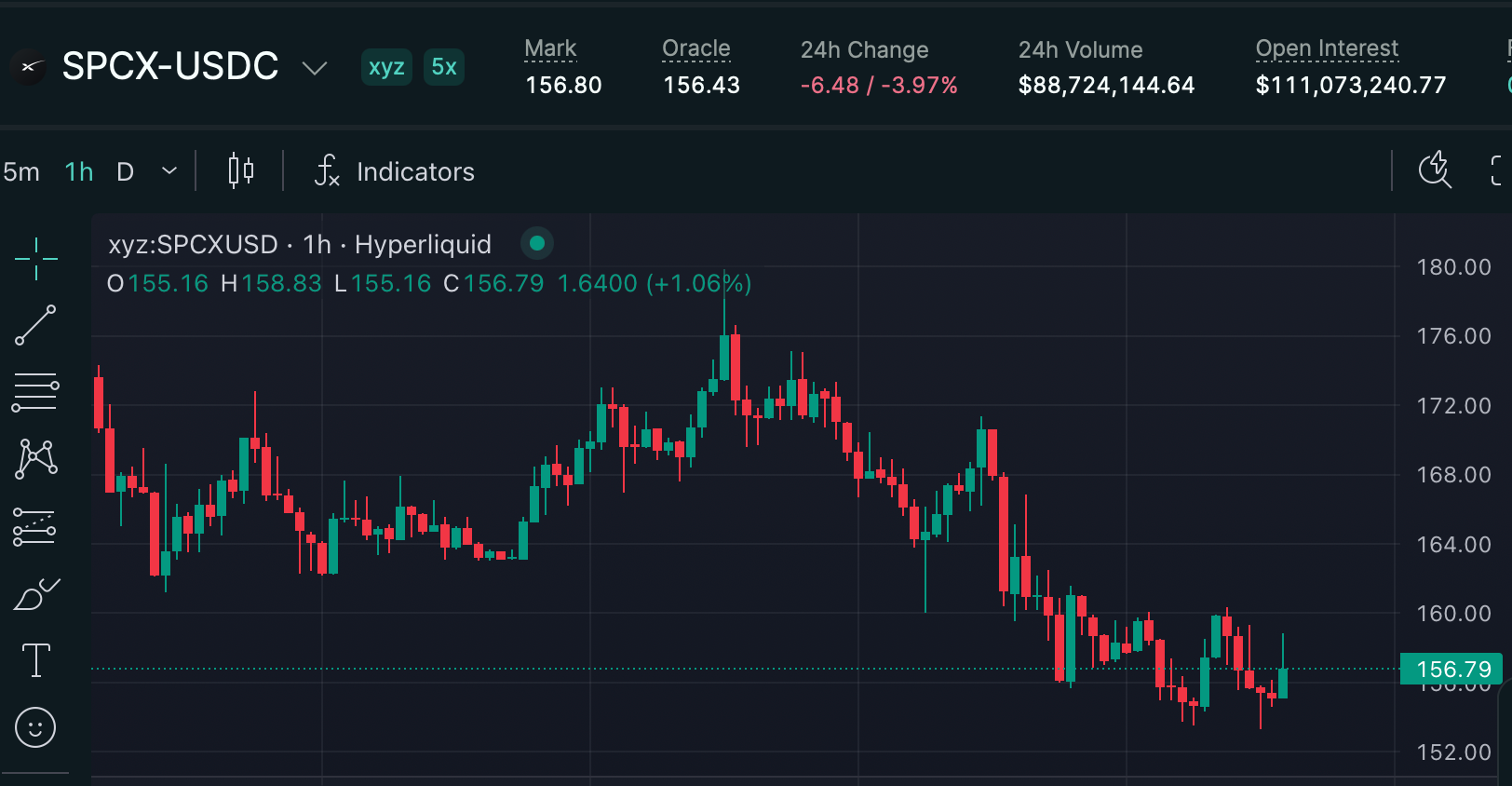
One potentially useful indicator comes from perpetual futures markets. In recent years, traders have increasingly used perpetual futures contracts to speculate on the future value of companies ahead of their public listings. While these markets are imperfect and can be volatile, they often offer a real-time glimpse into investor sentiment. Unlike traditional analyst reports, perpetual futures markets update continuously as new information becomes available. At the time of this writing, SpaceX was estimated to open for trading on June 12, 2026, at $156.80. This price is subject to change.
Source: Hyperliquid
Investors monitoring these markets between now and the June 12 opening may gain valuable insights into the evolving price discovery mechanism. If perpetual futures continue trading substantially above the $135 IPO price, that could indicate strong demand at launch. Conversely, if futures prices begin drifting below the IPO price, it could signal growing skepticism among market participants.
Historical comparisons offer additional perspective. When Tesla entered the S&P 500 in 2020, anticipation of forced index buying created significant upward pressure ahead of its inclusion. While SpaceX differs from Tesla in many respects, both companies share several characteristics that tend to attract investor enthusiasm: visionary leadership, disruptive technology, and strong retail investor engagement. The difference is that SpaceX’s initial valuation is already enormous, making comparisons difficult.
The challenge is that valuation and market structure may point in opposite directions. Fundamental models strongly suggest that the stock could be worth less than the IPO price, while market mechanics suggest it could trade substantially above it. Both arguments can be correct at the same time because valuation and price are not always the same, especially during an IPO.
One useful framework is to separate opening-day outcomes into three broad scenarios. In the bearish scenario, investors focus primarily on valuation concerns. Institutions conclude that the IPO price already reflects overly optimistic assumptions regarding growth, profitability, and future space-related opportunities. In such a case, the stock could trade between $100 and $130 during its first day. This outcome would align more closely with traditional valuation models and would likely disappoint investors expecting a dramatic opening surge.
A more moderate scenario assumes that both valuation concerns and passive inflows exert influence. Under this outcome, investors recognize that the stock may be expensive on conventional metrics but also acknowledge the substantial buying pressure that will emerge from index funds and benchmarked portfolios. In this environment, the stock could reasonably trade between $135 and $150 during its opening session. Such a range would represent a premium to the IPO price while remaining within historical norms for highly anticipated offerings.
Under a more bullish scenario that assumes scarcity overwhelms valuation concerns. Institutional investors compete aggressively for limited shares, retail demand surges, and traders attempt to front-run anticipated passive inflows. In that environment, prices could reach $150 to $200 on the first day. While such levels might appear extreme relative to traditional valuation estimates, they would not be unprecedented in markets where demand significantly exceeds available supply.
The most extreme projections envision a self-reinforcing feedback loop. Rising prices attract media attention and investor momentum. Additional demand pushes prices higher. Index funds continue buying. Short sellers become reluctant to challenge the trend because of the limited float. Such conditions could temporarily push the stock far above its fundamental value.
For investors attempting to estimate the opening-day price, the most important variable may not be valuation at all. Instead, it may be the balance between available float and immediate demand. The first few hours of trading will reveal how much stock long-term holders are willing to sell and how aggressively institutions seek to accumulate positions.
Based on our observation of SpaceX's futures trading price at the time of this writing, we project an opening-day price range of $135 to $160 per share, suggesting a first-day rise of up to 18% over the IPO price. This estimate accounts for expected passive investment flows and a limited float, while noting that many institutional investors view the IPO valuation as excessive. Moving significantly above this range would likely require an exceptionally strong supply-demand imbalance, whereas dropping below $135 would probably require surprisingly low institutional interest.
Summary and Concluding Thoughts
SpaceX’s opening-day price will likely reflect a temporary compromise between competing forces. Fundamental investors will focus on discounted cash flows, earnings potential, and long-term growth prospects. Passive funds will focus on benchmark requirements. Retail investors will focus on the company’s technological achievements and future ambitions. Traders will focus on momentum and liquidity. Each group will arrive with different objectives and different definitions of value.
The broader issue is that IPO pricing is often as much about market structure as it is about valuation. SpaceX may become one of the clearest examples of that principle in recent history. Whether the stock ultimately moves toward $60, $135, $160, or higher on the first day of trading will primarily reflect the interaction of supply, demand, and investor psychology. Yet, given current market dynamics, we strongly suspect the price will rise on the first day of trading! Only over the next several years will the market begin to answer the much harder question of SpaceX’s true worth.
This analysis is for informational and academic purposes only and does not constitute investment advice.